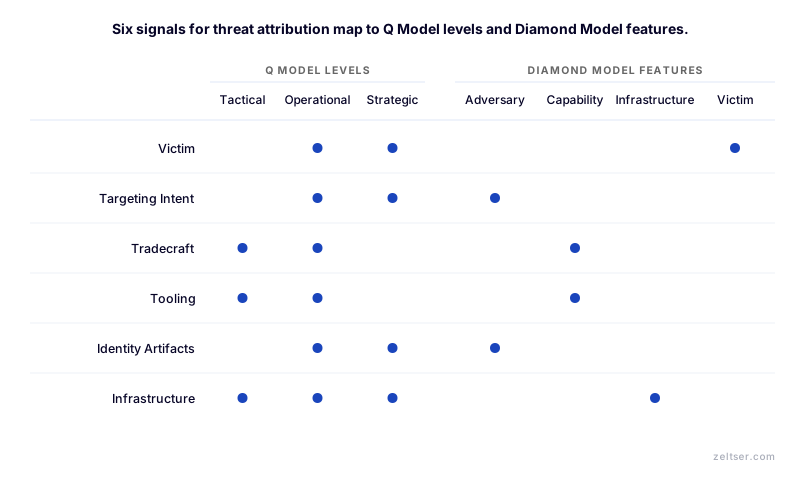
Credible threat attribution weighs six signals together. Each signal has a disciplined methodology behind it, with citations and stress tests to back the conclusions.

“A Chinese state-sponsored group.” “Tied to APT41.” “ShinyHunters.” Phrases like these appear in vendor advisories, government bulletins, and news coverage. We use them to inform response steps, vendor decisions, and conversations with leadership. The work that produces them is typically done by security vendors, government agencies, and enterprise threat intelligence teams. Some incident response teams track attribution signals when connecting an intrusion to a known cluster of activity.
Threat attribution is the process by which analysts link cyber intrusions to the actors behind them. They build attribution cases to defend against the next campaign, predict the actor’s next move, and share evidence-backed findings with customers, regulators, and partners. Whether you produce such conclusions or rely on them, let’s look at how the work gets done when the picture is incomplete and the stakes are high.
Three Levels of Attribution
Threat attribution has three levels, per Thomas Rid and Ben Buchanan’s “Attributing Cyber Attacks” (the Q Model), each requiring different evidence to support its claims:
- Tactical: We examine the incident’s technical aspects.
- Operational: We characterize the campaign and the actor running it.
- Strategic: We ask who is responsible and why the operation matters.
Across those levels, one way to build a rigorous attribution case is to weigh six signals: Victim, Targeting Intent, Tradecraft, Tooling, Identity Artifacts, and Infrastructure.
Victim: The Targeting Profile
When examining the Victim signal, we ask who was targeted and what sector the threat actor operates in. The Diamond Model of Intrusion Analysis by Sergio Caltagirone, Andrew Pendergast, and Christopher Betz treats Victim as one of four features for any intrusion. When targets share a profile, the Victim signal is a strong input to attribution.
The victim profile helps identify a potential threat actor and rule out one whose targets don’t fit. For example, a CISA joint advisory on Salt Typhoon identifies targets across telecom, government, transportation, lodging, and military networks. These sectors carry intelligence value and suggest a government-affiliated actor. A threat actor focused on e-commerce operations doesn’t fit this profile and is likely to be a different crew.
The Victim signal doesn’t work on its own, since threat actors can also pursue atypical or opportunistic targets.
Targeting Intent: What the Threat Actor Pursued
Targeting Intent is what a threat actor pursued, meaning the data, access, or operational effects they prioritized. By examining what a threat actor collects, copies, or destroys, we narrow the field of suspects.
A US Justice Department indictment of defendants tied to APT41 describes the theft of source code, software code-signing certificates, customer account data, and business information across a wide range of victim organizations. This combination of intelligence-style espionage and revenue-motivated theft became part of the attribution argument that APT41 operated with both state-aligned and criminally motivated objectives.
Motive can be hard to infer from Targeting Intent alone, and the signal gets stronger when infrastructure and tradecraft support the same conclusion.
Tradecraft: The Threat Actor’s Method
Tradecraft is an intelligence-community term for a threat actor’s habits, including lure documents, social-engineering pretexts, phishing tactics, and timing. MITRE ATT&CK organizes these behaviors under tactics such as Initial Access and techniques such as Phishing, with sub-techniques for spearphishing attachments, links, services, and voice. ATT&CK is useful for attribution because it gives analysts a shared vocabulary for behaviors that persist across campaigns.
A joint CISA-FBI-Treasury advisory on TraderTraitor describes how the Lazarus Group approached cryptocurrency-company employees in system administration and DevOps across a variety of communication platforms, with spearphishing messages that “mimic a recruitment effort and offer high-paying jobs” to deliver trojanized cryptocurrency applications. The same recruitment-style lure pattern recurred across years and platforms, allowing intelligence analysts to attribute new campaigns to the group.
Tradecraft alone doesn’t settle attribution, and the signal gets stronger when tooling, identity artifacts, and infrastructure support the same conclusion.
Tooling: The Threat Actor’s Toolchain
Tooling covers the malware families, frameworks, and custom code a threat actor uses. We can identify Tooling through toolmarks. Debug strings, embedded paths, language packs, compiler artifacts, custom encoding routines, and reused error-handling code all reveal fingerprints of the development environment. David Bianco’s “Pyramid of Pain” places tools close to the top of the indicator hierarchy because changing them is costly for the threat actor.
Public threat reports document the specific toolmarks of named campaigns. Some examples:
- The Salt Typhoon advisory mentioned earlier documents specific exploits and router-configuration commands the actors used, which lets defenders link new intrusions to the same group.
- Citizen Lab’s review of Amnesty International’s Pegasus methodology walks through process names, installation-server traffic, and iOS backup patterns that attribute a compromise to NSO Group’s Pegasus spyware, narrowing the field to NSO’s government customers.
Tooling evidence supports attribution only when it accumulates across multiple operations. The signals are consistent enough for defenders to hunt on and for analysts to cross-check. However, threat actors can strip compiler metadata, randomize string tables, and rotate their toolchain.
Threat actors can also forge toolmarks to mimic other groups. The Olympic Destroyer malware that hit the PyeongChang Winter Olympics carried a forged header that mimicked the Lazarus Group’s fingerprints, and initial analysis pointed to North Korea. Kaspersky’s GReAT team reconstructed the deception, and a US Justice Department indictment later named six GRU officers for the attack.
Identity Artifacts: The Threat Actor’s Trail
Identity Artifacts are the trail threat actors leave behind, including code-signing certificates, domain registrant data, email and persona reuse, and payment trails. They cut across operational and strategic levels. Reused identities can become some of the most durable evidence in an attribution case.
A persona-reuse trail can sometimes lead investigators to a threat actor’s real identity. In one KrebsOnSecurity investigation, Brian Krebs traced the handle “Judische” through years of cybercrime forum activity, finding the same person posting on Telegram and Discord under the nickname “Waifu.” That persona trail was part of the investigation that led to an arrest in Canada for the Snowflake extortions.
Identity Artifacts can also be stolen, sold, or planted, so analysts test whether the identity trail is consistent with the victim profile, the tradecraft, and the infrastructure.
Infrastructure: The Network and Hosting Footprint
Infrastructure is the network and hosting footprint a threat actor builds, including command-and-control domains, IP addresses, registration patterns, hosting providers, and the time each component came online. It spans tactical, operational, and strategic attribution. The Diamond Model treats Infrastructure as one of its four core features. The attribution value of Infrastructure comes from connections across operations rather than from any single indicator.
A US Justice Department indictment of twelve GRU officers for the DNC intrusion is an example of infrastructure-driven attribution. It documents three connected patterns:
- The same servers used across several intrusions
- A cryptocurrency pool that funded the infrastructure leasing and the registration of related domains
- The same hosting used for both the intrusion and the “Guccifer 2.0” and “DCLeaks” personas that distributed the stolen data
Prosecutors built the case on the pattern of reuse, with the same Bitcoin funding the infrastructure and the same units operating it.
Infrastructure tracking gets stronger across time. Threat actors can rotate domains, switch providers, and burn campaign infrastructure quickly, but we can spot reuse patterns across many operations.
A Disciplined Approach to Attribution
A disciplined approach to attribution involves weighing signals for convergence, carefully labeling confidence, and testing competing explanations against the evidence.
The six signals work as a connected system rather than a checklist. A key insight of the Diamond Model is that analysts pivot across features, using a finding at one corner to ask questions at another. The same evidence can feed multiple signals. A code-signing certificate, for example, is Tooling evidence about a binary or an Identity Artifact about the cert holder. The strongest attribution arguments come from several signals converging.
Labeling confidence is part of this discipline. The US Intelligence Community formalized this practice in Intelligence Community Directive 203, which has shaped how analysts across government and commercial threat intelligence express confidence levels. In attribution work, we can label confidence as high, moderate, or low, identify what would change the assessment, and distinguish observation from inference.
Intelligence analysts also test competing explanations against the evidence. The Analysis of Competing Hypotheses, developed at the CIA by Richards J. Heuer Jr., is a structured method for weighing each attribution hypothesis against the signals. Using it involves listing all plausible attributions, then asking which signals fit each one and which contradict it. After comparing the hypotheses, we report the one the evidence supports, along with any alternatives we couldn’t rule out.
Each signal is partial and has known limits, but together they let us build a rigorous attribution. If the signals converge, we report what we found and our level of confidence. If they don’t, we say so. Either way, the work is credible when we follow this discipline.